Moving can be both exciting and overwhelming, especially when your child has unique needs. The goal isn’t a perfect transition; it’s a predictable, supported one. Use this guide to plan early, reduce surprises, and give your child (and yourself) plenty of wins along the way.

Guide decisions with what matters most

Before you look at boxes or floor plans, define three non-negotiables for your child (e.g., school services, accessible layout, proximity to therapists). Write them down and use them as your filter for every decision, from housing to timelines. If stress rises or choices feel murky, return to those anchors to keep priorities in focus.

Build a predictable story of “what’s changing” and “what stays the same”

  • Create a simple social narrative with photos of the new home, neighborhood, and routes you’ll take.
  • Label constants: the same bed, favorite blanket, nightly story, morning snack.
  • Use a move countdown calendar with stickers to visualize the steps: “Pack toys,” “Say bye to playground,” “First night in new room.”

Make the new space work for your child on day one

  • Safety first: door chimes, outlet covers, cabinet locks, baby gates, window guards where needed.
  • Sensory zone: a small corner with a beanbag, noise-reducing headphones, and comfort items for quick regulation.
  • Lighting and noise: soft bulbs, blackout shades if light sensitivity is a factor; a white-noise machine for new sounds.

Map services and supports before you move

  • School: contact the new district early. Request an IEP transfer meeting, share recent evaluations, and ask about comparable services start dates.
  • Therapies: secure referrals and waitlist spots for OT/PT/speech/ABA (if applicable) as soon as you have a target move window.
  • Medical: request complete records, a current medication list, and care summaries; schedule telehealth bridges so care doesn’t lapse.

Do a dry run

  • Practice the drive to the new school or therapy location on the same day/time as you’ll commute.
  • Visit nearby parks, libraries, and grocery stores to build familiarity and positive associations.
  • If possible, arrange a brief meet-and-greet with the new teacher or case manager before the first day.

Pack with regulation in mind

  • First-day box: favorite snacks, meds, pajamas, comfort items, toothbrush, nightlight, tablet/chargers, and a small toolkit.
  • Color code boxes by room using big, clear symbols (stickers) your child can recognize.
  • Let them help choose two or three items to keep out until the last minute and unpack first on arrival.

Routine bridging: keep the rhythm, tweak the details

  • Maintain wake/sleep windows and mealtimes during the move days.
  • Keep rituals in place (prayer, song, story, stretch) even if locations change.

  • Use visual schedules or a simple whiteboard to show each day’s plan.

Plan sensory supports for moving day

  • Assign a quiet space away from the bustle—a sitter in their home, the neighbor’s living room, or a cleared room with the door closed.

  • Offer predictable breaks: every 45–60 minutes, pause for water, snack, and a sensory tool your child likes (chewy, fidget, weighted lap pad).

  • If your child is a runner or eloper, designate one adult as the “buddy” at all times.

School and IEP handoff made simpler

  • Create a one-page “About My Child” profile with strengths, triggers, calming strategies, communication preferences, and key accommodations.
  • Bring copies of the IEP/504, recent evals, and data sheets; request temporary comparable services to start while formal meetings are scheduled.
  • Ask for the special education bus/transportation plan early if needed.

Communication tools that smooth the transition

  • Teach a few go-to phrases or cards (AAC buttons, PECS, or scripts) for new situations: “I need a break,” “Bathroom please,” “Too loud.”
  • For nonspeaking kids, pre-program new place words into their device (school name, teacher, street, park).
  • Share common signs (bathroom, break, help) with new caregivers and teachers.

Accessibility and safety walk-through at the new home

  • Clear pathways wide enough for mobility devices; check thresholds and rug edges.
  • Evaluate bathroom setup for grab bars, non-slip mats, and a shower chair if needed.
  • Check kitchen and laundry appliance controls (tactile markers, knob covers) for safety.

Help siblings feel seen

  • Give each sibling a special role (label captain, plant caretaker, pet helper).

  • Plan one small one-on-one outing with each child in the first two weeks—stability grows when attention feels fair.

Normalize big feelings

  • Name emotions without judgment: “New can feel exciting and wobbly.”
  • Have a “feelings basket” ready—gel timers, squeeze balls, coloring, calming cards—to externalize stress in age-appropriate ways.
  • Celebrate small wins daily: a new friend, a calm bedtime, a successful bus ride.

A simple two-week transition plan

Week 1: Before the Move

  • Finalize the top three priorities and confirm school/therapy contacts
  • Build the social story and countdown calendar
  • Pack the first-day box and color-code system; collect records and meds refills

Week 2: Arrival Week

  • Set up the sensory corner and safety items first
  • Unpack the bedroom and bathroom before shared spaces
  • Do the school/therapy practice runs and quick introductions
  • Hold a 15-minute family huddle nightly: “What went well? What felt hard? What do we change tomorrow?”

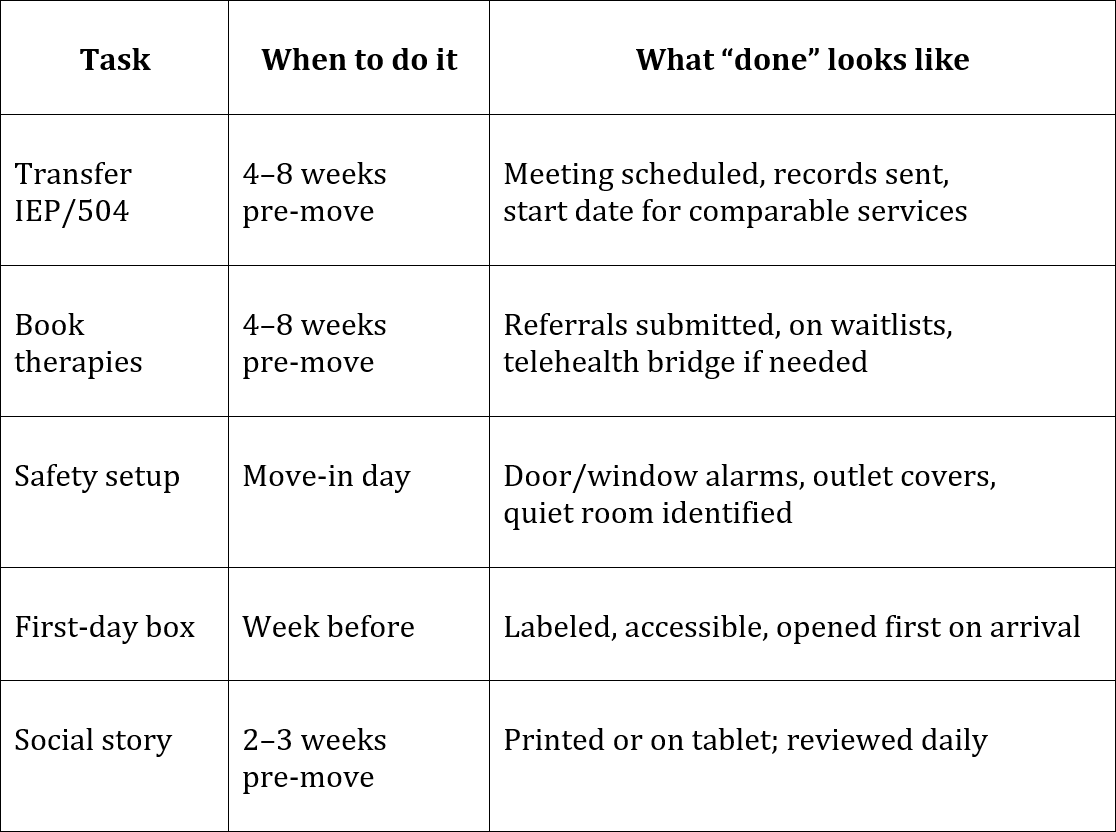
Quick reference table

After you land: give it time

Expect a 4–6 week adjustment curve. Keep routines steady, debrief daily, and increase demands slowly. Celebrate progress you might normally overlook—sleeping through, trying a new route, handling a surprise without a meltdown.

When to ask for extra help

If sleep, eating, or behavior changes persist beyond a few weeks, or if your child loses key skills, check in with your pediatrician, therapists, or a behavior specialist. Early tweaks can prevent small wobbles from becoming potholes.

Gentle reminder

A successful move isn’t measured by zero meltdowns or perfect timelines. It’s measured by how supported your child feels, how clearly you protect the essentials, and how calmly you adjust. Lead with predictability, keep your priorities visible, and take it one small step at a time—you’ve got this.

Schedule a Call

Have some questions? Let’s chat about it!